
Hotline: +86 138 2658 5001
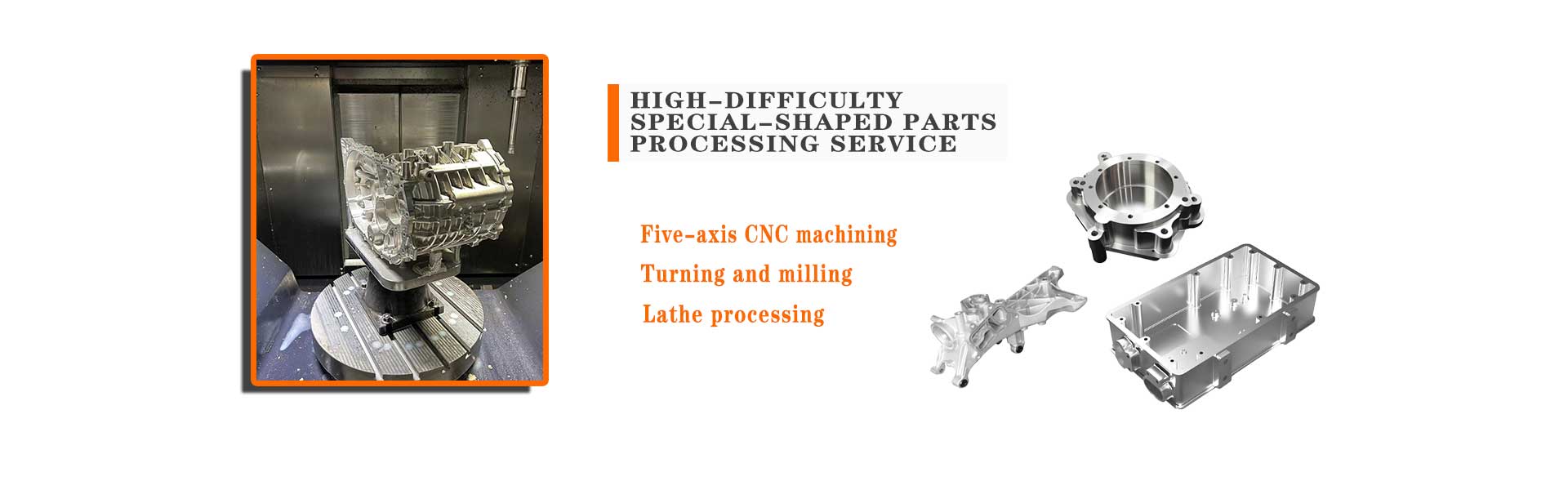
Five-axis CNC machining: Five forms
The first type is the double-head return method, where the two rotational coordinates directly control the direction of the tool axis.
The second one is the drooping rotary head type, with two coordinate axes at the top of the cutter, but the rotary axis is not perpendicular to the linear axis.
The third one is the dual turntable mode, where two rotational coordinates directly control spatial rotation.
The fourth one is the drooping worktable. There are two axes on the worktable, but the rotating axis is not perpendicular to this axis.
The fifth one is a swing starting from a rotation, with two rotational coordinates, one on the tool and the other on the workpiece.
Chenju Precision focuses on precision parts processing services, offering 3-axis, 4-axis, and 5-axis CNC machining, turning and milling compound processing, CNC lathe processing, and small batch parts processing, etc. It excels in complex structural parts and can customize special fixtures and jigs for projects. Each product undergoes at least four full inspection procedures, with a quality pass rate of 99.93%. It provides high-quality small batch processing customization services for customers, with sample production within 3 days and delivery within 7 days.
Five-axis CNC machining is a numerical control processing technology that can perform processing operations simultaneously in multiple directions. Traditional three-axis CNC machining can only process in the X, Y, and Z three linear directions, while five-axis CNC machining can process in the X, Y, and Z three linear directions, and also in the A and B two rotational directions.
The main advantage of five-axis CNC machining lies in its ability to process more complex parts, especially those with complex curved surface shapes or requiring processing from multiple angles. By rotating the worktable or the tool head, five-axis CNC machines can perform machining from different angles, thereby achieving higher machining accuracy and better surface quality.
Five-axis CNC machining is widely used in fields such as aerospace, automotive manufacturing, and mold making. It can be used to process complex turbine blades, automotive body surfaces, and complex concave-convex surfaces in molds. Compared with traditional processing methods, five-axis CNC machining can significantly improve production efficiency and product quality.
Of course, five-axis CNC machining also has some challenges and limitations. Firstly, five-axis CNC machines are more expensive and require more complex mechanical structures and control systems. Secondly, five-axis machining requires higher programming and operational skills, and thus has higher demands on operators. Additionally, due to the more complex relative motion between the cutting tool and the workpiece during the machining process, the risk of collision may increase, necessitating meticulous process planning and safety measures.
Overall, five-axis CNC machining is an excellent processing technique that can complete the processing of more complex parts, improve production efficiency and product quality. Its application prospects in the manufacturing industry are broad and it will continue to drive the development of the manufacturing industry.
Chenju Precision focuses on precision parts processing services, offering 3-axis, 4-axis, and 5-axis CNC machining, turning and milling compound processing, CNC lathe processing, and small-batch parts processing, etc. It excels in complex structural parts and can customize special fixtures and jigs for projects. Each product undergoes at least four full inspection procedures, with a quality pass rate of 99.93%. It provides high-quality small-batch processing customization services, with sample production within 3 days and delivery within 7 days.
Why does workpiece deformation occur in CNC machining?
The magnitude of deformation is directly proportional to the complexity of shape, the aspect ratio and the thickness of the wall, and is also directly proportional to the rigidity and stability of the material. Therefore, when designing parts, it is necessary to minimize the influence of these factors on the deformation of the workpiece as much as possible.
Deformation caused by workpiece clamping
When clamping the workpiece, the correct clamping points should be selected first, and then the appropriate clamping force should be chosen based on the position of the clamping points. Therefore, it is advisable to make the clamping points and the support points consistent as much as possible, so that the clamping force acts on the support. The clamping points should be as close as possible to the processing surface and be selected at positions where the force is unlikely to cause clamping deformation.
Deformation caused during workpiece processing
During the cutting process, the workpiece undergoes elastic deformation in the direction of the cutting force, which is what we commonly refer to as tool deflection. On the one hand, it reduces the resistance caused by the friction between the tool and the workpiece; on the other hand, it enhances the heat dissipation capacity of the tool when cutting the workpiece, thereby reducing the residual internal stress on the workpiece.
4. Stress-induced deformation after processing
Separating rough and finish machining helps to reduce the influence of cutting force and heat, allowing the deformation of sleeve parts caused by rough machining on CNC lathes to be corrected during finish machining.
2. Reduce the influence of clamping force. The following measures can be taken to reduce the influence of clamping force:
3. Reduce the influence of cutting force on deformation. The main measures are as follows:
3) Simultaneous processing of the inner and outer cylindrical surfaces enables the cutting forces to cancel each other out.
Chenju Precision focuses on precision parts processing services, offering 3-axis, 4-axis, and 5-axis CNC machining, turning and milling compound processing, CNC lathe processing, and small-batch parts processing, etc. It excels in complex structural parts and can customize special fixtures and jigs for projects. Each product undergoes at least four full inspection procedures, with a quality pass rate of 99.93%. It provides high-quality small-batch processing customization services for customers, with sample production within 3 days and delivery within 7 days.
Machining accuracy refers to the degree of conformity between the actual geometric parameters (size, shape and position) of a part after processing and the ideal geometric parameters. Generally speaking, the higher the degree of conformity, the higher the machining accuracy. In actual processing, it is impossible to make the part exactly the same as the ideal one, and there will always be deviations of different magnitudes. The degree of deviation of the actual geometric parameters of the part after processing from the ideal geometric parameters is called machining error. It was only after consulting our senior machining master from Chenju Precision that I learned about this accuracy issue.
The factors that affect machining accuracy and cause machining errors can be classified into three aspects:
(2) Errors inherent in the machine tool, fixtures and cutting tools themselves;
(3) Errors during the adjustment of work, fixtures and cutting tools.
2. Errors caused by physical factors during the cutting process:
(1) Cutting forces and other forces cause deformation of the process system;(2) Cutting heat and other heat sources cause deformation of the process system.
3. Errors that occur after cutting:
Deformation caused by the redistribution of internal stress in the workpiece;(6) Measurement Error
Chenju Precision focuses on precision parts processing services, offering 3-axis, 4-axis, and 5-axis CNC machining, turning and milling compound processing, CNC lathe processing, and small batch parts processing, etc. It excels in complex structural parts and can customize special fixtures and jigs for projects. Each product undergoes at least four full inspection procedures, with a quality pass rate of 99.93%. It provides high-quality small batch processing customization services for customers, with sample production within 3 days and delivery within 7 days.
In ChenJu Precision, our technical sales staff will response to your custom CNC machining parts within 30 minutes with 1-to-1 online service. you will get the professional advice and save you R&D time.
get an instant quote